What It Means to Lose Your Hair in a World That Worships It
Written by Tami Wong
Hair loss affects millions of women, yet it remains one of the most stigmatized and invisible experiences tied to beauty and identity. In this personal essay, Tami Wong explores what it means to lose your hair as a woman, why so many suffer in silence, and what happens when an entire group is left out of the spaces where beauty is defined.
I started losing my hair when I was 15.
Prior to this, I was a teenager dealing with cystic acne and deep insecurity about my appearance. My mother took me to a dermatologist, hoping to help me feel better in my own skin. I was prescribed a powerful new acne medication and told I’d need to take it for five months. I believed this was going to transform my life for the better.
Instead, it took my life in a direction I never expected.
Not long after starting the medication, my hair began to change. First, the texture went from thick and coarse to fine, brittle, and broken. Then, my part started to widen noticeably. I will never know whether the medication caused my hair loss outright or triggered something that was already present in my body. What I do know is that every woman in my family had thick hair. So did I… until I took that medication.
As my hair thinned, I felt like I no longer belonged anywhere. Not in my family. Not among my peers. I didn’t know a single other teenage girl losing her hair. This was nearly 30 years ago. I had never heard the word alopecia. I had never heard a woman talk openly about hair loss. There was no language, no representation and no roadmap.
So I hid.
I cut my hair short. I highlighted it to distract from the widening part and thinning crown. I wore it up constantly. I stopped swimming and avoided washing my hair at the gym because when my hair was wet, my scalp was visible. I refused to let anyone see me that way. To me, hair loss equaled ugliness, and ugliness felt unforgivable.
In college, I tried topical Rogaine briefly, but it wasn’t a great solution for me due to my diffuse thinning. At 22, I moved away from my hometown to start my first job, and I decided that distance gave me permission to try wearing a wig for the first time.
I was living in a small town in Nebraska, and I drove two and a half hours to the nearest big city that had a wig store. I was desperate and didn’t know what I was looking for, so I bought a synthetic wig that didn’t look like me at all. It was thick, itchy, and completely wrong. I wore it for less than a year, and it absolutely killed my confidence. This “solution” made me feel more exposed, not less.
Over the next ten years, hair fibres, strategic curls, short styles, and constant monitoring were my tools. I would spend an hour doing my hair and still hate how it looked. Roughly 17 years of my life were consumed by shame, anxiety, and isolation.
I believed my hair loss made me unlovable.
That belief was reinforced in my early twenties when I finally worked up the courage to tell someone I was dating that I had alopecia. He assured me it didn’t matter, but within a week, he ended things. I promised myself I wouldn’t tell another man until I felt “secure enough.” For the next six years, I hid my hair loss from everyone I dated. I woke up early to apply hair fibres to cover my bald spots. I avoided wind and rain. I lived in constant fear of being found out.
That kind of hypervigilance erodes you.
When I was 28, I met my now-husband. A month into dating, I knew I had to tell him. I felt like he might be different from the other men I’d dated; the ones I could never be my full self with. I sat him down and warned him that what I was about to tell him might change how he felt about me. His response to my admission was simple: “That’s it? I thought you were going to tell me you were dying.”
He didn’t care; not even a little.
That moment cracked something open. It gave me safety, and it finally gave me a voice.
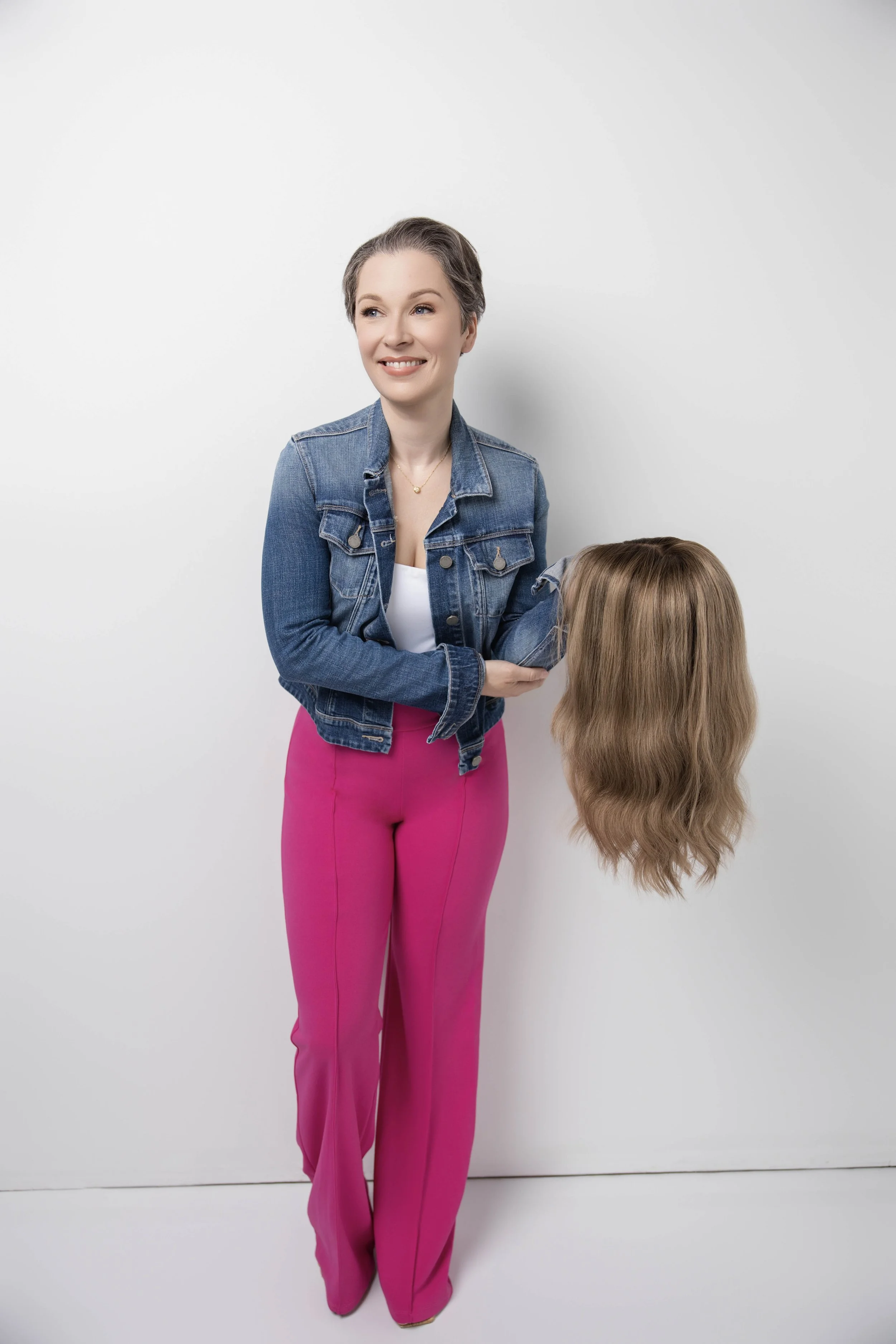
I started wearing wigs again about 12 years ago, and I’ve never looked back. This time, it was different, because wigs didn’t feel like a disguise. They felt like freedom. I stopped obsessing over every strand I was losing and started enjoying hair again.
More importantly, I started talking about my hair loss. When someone complimented my hair, I would immediately tell them, “thanks, it’s a wig!” People were shocked. Everyone wanted to know more: why I wore wigs, if they were uncomfortable, and how expensive they were. I was able to have meaningful conversations that brought more awareness to what alopecia was, and that it didn’t just affect people who were older or sick. It could happen to a healthy, young woman who they saw every day, and it didn’t stop me from living my life. I became known at work for my colourful heels and my changing hair. Coworkers had their favourite wigs. They loved when I got a new one, and they constantly exclaimed how jealous they were that I always had perfect hair. It was quite the shift for me; to go from hiding my hair for years to being complimented on it daily.
About 55% of women will have noticeable hair loss by the age of 70. And yet, female hair loss remains one of the most stigmatized and invisible wellness issues women face.
In my work today, I see the impact every day. Hair loss affects confidence, identity, mental health, relationships, and how women show up in the world. It is not cosmetic. It is emotional, it is psychological, and it is routinely dismissed.
Hair loss in women is treated as something to quietly manage, fix, or hide. Meanwhile, male hair loss is normalized, joked about, even expected. The double standard is exhausting and deeply harmful.
Society defines beauty through thick, long hair. Shampoo commercials. Fashion campaigns. Red carpets. Runways. When women lose their hair, we lose a social currency we were told we needed to be worthy.
When that loss happens suddenly through autoimmune disease, trauma, or cancer, the grief can be profound. Hair loss changes how we recognize ourselves. It changes how others respond to us. Many women retreat from life altogether.
After 20 years working in the healthcare industry in physical therapy and biotech, I founded Hair Loss Pride in September of 2024 because I could no longer ignore the gap.
Women were receiving diagnoses and being sent home with no mental health support, no resources, no community. Just search online and suffer in silence.
Hair Loss Pride exists to change that. Through coaching, a support community, wig consultations, and salon education, my ultimate goal is to help women stop hiding and start rebuilding their sense of self.
Community support is only one piece of the work ahead. Representation matters deeply too.
Inclusivity has expanded in meaningful ways within beauty and fashion, and that progress deserves to be acknowledged. We see curvy models, people with disabilities, visible skin conditions, and broader gender representation than ever before. These shifts matter. They save lives. They tell people they belong.
Yet, women with hair loss remain almost entirely absent from the spaces where beauty is defined.
Occasionally, brands will feature completely bald women, but even that is still rare. Women with thinning hair, with androgenic alopecia like mine, women who exist in the in-between, are nowhere to be found. We are not reflected in campaigns, on runways, or on brand websites.
That absence is not neutral.
When women with thinning hair never see themselves represented, the message is clear: you are not beautiful enough to be seen. You are something to fix or hide. That message reinforces shame, isolation, and the belief that our bodies are somehow wrong.
My biggest goal for 2026 is to change that.
I am actively reaching out to beauty and fashion brands across Canada, advocating for the inclusion of women with hair loss in their website imagery, marketing campaigns, and social media presence. Not as a niche moment. Not as a “before and after,” but as women who are already whole.
I believe deep healing happens when women see themselves reflected and celebrated. Visibility cracks shame. Representation creates permission. And when women with hair loss are finally seen as part of the beauty conversation, it shifts how we see ourselves and how the world treats us.
I will keep doing this work until that happens, because women with hair loss don’t deserve to struggle like I did. They deserve full, rich lives where they never have to question their worth to society or themselves.